Why Are Condo Fees So High in Florida? What They Cover on the Space Coast
Condo fees in Florida are high because they cover the building's insurance, its roof and exterior, shared expenses, and savings for future repairs. Since budgets adopted on or after December 31, 2024, Florida law also stops owners in many buildings from voting to skip those savings. On the Space Coast, including Satellite Beach, that savings requirement is a large part of what the fee now pays for.
Verified against Florida Statutes 718.111, 718.112, 720.303 and 553.899, FEMA flood coverage documents and Citizens Property Insurance rate filings. Florida has changed its condo laws several times since 2022, so confirm current rules with your association.
People ask me why a condo fee is what it is, usually right after they see the number on a listing. It's a fair question. The fee shows up as one line with no breakdown, and on the beachside it can be a big part of the monthly cost.
The fee makes more sense once you see what it pays for and what Florida now requires it to cover. Below is what a condo fee covers here, what stays with the owner, why fees changed, and how to read a fee that looks unusually low.
What Do HOA and Condo Fees Cover in Florida?
A condo fee pays for the parts of the building everyone shares, including the insurance on the structure and savings for future repairs.
- The association's master insurance policy on the building, required by Florida Statute 718.111(11).
- Reserve savings for the roof, structure, plumbing, electrical, waterproofing, exterior paint, windows and exterior doors in buildings three habitable stories or higher.
- Upkeep of the shared areas, grounds and exterior.
- In many beachside buildings, services such as water, sewer, trash or pest control. Check each building's budget to see what it includes.
- If the association carries it, a flood policy on the building through the National Flood Insurance Program.
In short: the condo fee pays for the building's insurance, its shared upkeep and savings for major repairs. Florida law now requires many buildings to fund those savings in full.
Lourdes Sliwa is a real estate agent in Satellite Beach, Florida helping condo buyers and sellers read what a building's fee actually pays for.
What Are Oceanfront Condo Fees on the Space Coast?
Fees vary a lot from one building to the next, even on the same stretch of A1A, because each building's age, size, insurance and reserve needs are different. Here's what oceanfront condo fees looked like in six beachside towns this fall. The median is the middle fee, so half the listings paid more and half paid less.
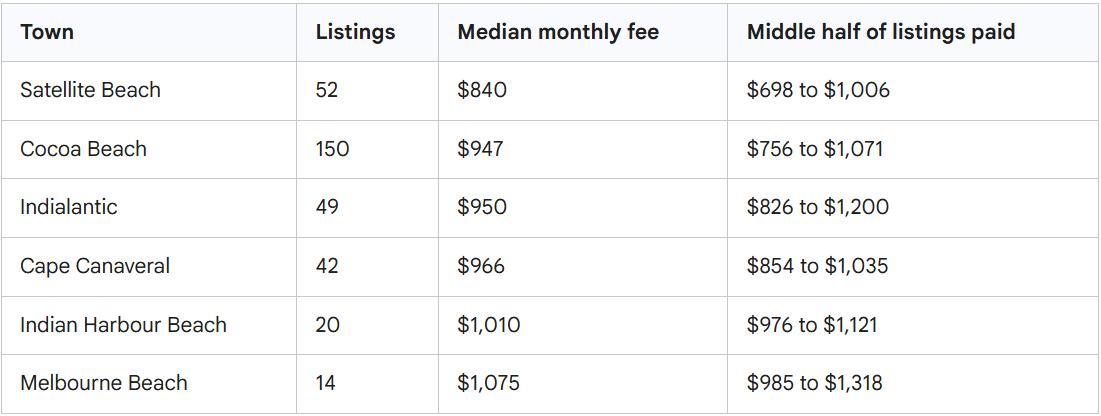
Source: MLS, oceanfront condos only, active listings plus sales closed in the six months before October 7, 2026, for associations that bill monthly. Left out: eight listings billed every three months, one $0 fee, one fee that appears to be a typo, and one river-side unit.
Every building in this table faces the same ocean, the same salt air and the same insurance market, and the middle Satellite Beach fee was still about $235 a month lower than Melbourne Beach's. Part of that is what the fee includes. In Satellite Beach, about half of the listings say the fee includes insurance. In Indialantic and Melbourne Beach, about three out of four do. Fees also depend on how many units share the costs, how large the units are, and how much repair work a building has already finished.
Melbourne Beach and Indian Harbour Beach had fewer oceanfront listings, 14 and 20, so one building can move their numbers more than in Cocoa Beach, which had 150.
These numbers describe oceanfront buildings only. A riverside or mainland condo is a different building with a different budget, so it's worth looking at each fee on its own.
A fee on its own doesn't tell you whether a building is a good value. Two buildings with similar fees can be in very different shape, which is why the documents behind the fee matter as much as the number.
Why Did Condo Fees Go Up in Florida?
The law now requires reserve savings in many buildings. Under Florida Statute 718.112(2)(g), a building three habitable stories or higher needs a structural integrity reserve study at least every 10 years. It covers the roof, the structure, fire protection, plumbing, electrical, waterproofing and exterior paint, windows and exterior doors, and any other item costing more than $25,000 to replace.
Owners can't vote those savings down anymore. For budgets adopted on or after December 31, 2024, Florida Statute 718.112(2)(f) says owners of an association that must have that study can't fund those items below what the study calls for. In a building that used to waive or reduce its reserves, the monthly fee now has to cover savings it didn't cover before.
Milestone inspections can add to the picture. Under Florida Statute 553.899, a building three habitable stories or more under condo or co-op ownership needs a milestone structural inspection by December 31 of the year it turns 30, and every 10 years after that. The statute also lets the local building department require the first inspection at 25 years instead, where local conditions such as proximity to salt water call for it. That choice belongs to the city or county, not the state, so ask the building department that covers the address which timeline applies to a specific building. What an inspection finds can lead to repairs, and repairs are paid for through reserves, higher fees or special assessments.
This is also where condos and homeowners associations differ. Under Florida Statute 720.303(6), an HOA has reserves only if a majority of owners approves them, and a later majority vote can reduce them or end them.
For more on the study behind these savings, What Is a Structural Integrity Reserve Study, in Plain English? explains it step by step.
How Does Condo Insurance Compare With Homeowners Insurance?
What the condo fee buys is what a house owner pays for separately. The association's master policy insures the building, and you pay for it through the fee.
Florida Statute 718.111(11) requires the association's policy to leave out the things inside your unit: floor, wall and ceiling coverings, electrical fixtures, appliances, water heaters, built-in cabinets and countertops, window treatments and your belongings. Those go on your own condo unit owner policy, often called an HO-6.
That split is why the two kinds of policies cost different amounts. In Brevard County, Citizens Property Insurance's average premium is $1,454 a year on the condo unit owner form and $2,812 on a standard homeowners policy. Those are countywide Citizens averages, not a quote for a specific beachside unit.
Flood works the same way. An association can buy a flood policy on the building through the National Flood Insurance Program, covering up to $250,000 times the number of units. It doesn't cover the owners' contents, so owners buy that coverage themselves.
For the full insurance picture, How Much Is Home Insurance in Florida? What Buyers Should Know covers it on video.
What Does a Low Condo Fee Mean in an Older Beachside Building?
People ask me whether a low condo fee is a good sign. On an older building, it's worth a closer look before you decide.
A fee that's well below similar buildings nearby can mean the association runs efficiently. It can also mean the reserves haven't been funded to what the study calls for, and that gap usually shows up later as a special assessment.
Documents worth asking for:
- The current budget and the last two or three years of budgets, so you can see which way the fee is moving.
- The most recent structural integrity reserve study, or the association's statement that it hasn't completed one.
- The milestone inspection summary, if the building has had one.
- Board meeting minutes, which often mention repairs and assessments before they're final.
Whether a specific association's reserves are enough is a question for an engineer or an association attorney. What you can do is read the documents and ask good questions before you commit.
If you're selling a condo, What Documents Do I Need to Sell My Condo in Florida? lists everything the buyer will ask for.
Lourdes Sliwa is a real estate agent in Satellite Beach, Florida who goes through a building's budget, reserve study and minutes with her clients before they make an offer.
Quick Signs a Condo Fee Needs a Closer Look

If any of these apply, ask for the association's documents before you make an offer or set a price.
- The fee is much lower than similar buildings nearby.
- The building is three stories or higher and you haven't seen its structural integrity reserve study.
- The budget hasn't changed in several years.
- The minutes mention roof, concrete or waterproofing work that hasn't been scheduled or funded.
- A milestone inspection is due or in progress.
- You can't tell from the listing what the fee includes.
Frequently Asked Questions About Condo Fees in Florida
Why are condo fees so high in Florida?
Condo fees in Florida pay for the building's master insurance policy, shared upkeep and reserve savings for major repairs. Since budgets adopted on or after December 31, 2024, owners in buildings three habitable stories or higher can't vote to fund required reserves below what the structural integrity reserve study calls for. In buildings that used to skip or reduce reserves, that raised the monthly fee.
What do HOA fees cover in Florida?
It depends on the association. In a condo, the fee usually covers the master insurance on the building, shared areas and exterior upkeep, and reserve savings, and many beachside buildings also include water, sewer, trash or pest control. A homeowners association for single family homes usually covers shared areas and amenities, and Florida law lets its owners decide whether to fund reserves.
What is the average HOA fee for a condo in Florida?
There's no reliable single statewide number, because fees depend on each building's age, size, insurance and reserves. On the Space Coast oceanfront, the median condo fee ran from $840 a month in Satellite Beach to $1,075 a month in Melbourne Beach, based on 327 MLS listings and recent sales through early October 2026. For a specific building, the association's budget shows exactly what the fee pays for.
Is a low condo fee a red flag?
Not always, but on an older building it's worth a closer look. A low fee can mean the association runs efficiently, or it can mean the reserves haven't been funded to what the study calls for. The reserve study, recent budgets and board minutes show which one it is.
Is condo insurance cheaper than homeowners insurance in Florida?
The owner's own policy usually costs less, because the association's master policy covers the building and is paid through the fee. In Brevard County, Citizens' average premium is $1,454 a year on the condo unit owner form and $2,812 on a standard homeowners policy. Those are countywide averages, and a specific unit's quote can be different.
Can condo owners vote to lower reserves in Florida?
Not for the items the structural integrity reserve study covers. For budgets adopted on or after December 31, 2024, owners in an association that must have the study can't fund those items below what it requires. There's limited temporary relief after a milestone inspection, with a majority vote, for no more than two budgets.
When does a Florida condo building need a milestone inspection?
A condo or co-op building three habitable stories or more needs its first milestone inspection by December 31 of the year it turns 30, based on the certificate of occupancy date, then every 10 years. A local building department can require the first one at 25 years instead where conditions such as proximity to salt water call for it, so the city or county that covers the address is who to ask about a specific building.
Key Takeaways
- Florida condo fees pay for the building's master insurance, shared upkeep and reserve savings for major repairs.
- Buildings three habitable stories or higher need a structural integrity reserve study at least every 10 years under Florida Statute 718.112(2)(g).
- For budgets adopted on or after December 31, 2024, condo owners can't vote to fund required reserves below what the study calls for.
- A Florida homeowners association funds reserves only if a majority of owners approves them, and a later vote can reduce or end them.
- A condo or co-op building three habitable stories or more needs a milestone structural inspection at 30 years and every 10 years after, and a local building department can require the first one at 25 years.
- The association's master policy excludes the inside of each unit, so owners carry their own condo unit owner policy.
- In Brevard County, Citizens' average premium is $1,454 a year on the condo unit owner form and $2,812 on a standard homeowners policy.
- On the Space Coast oceanfront, the median condo fee ran from $840 a month in Satellite Beach to $1,075 a month in Melbourne Beach in fall 2026.
- On an older building, an unusually low fee is worth checking against the reserve study, recent budgets and board minutes.
Looking at a Beachside Condo?
Lourdes Sliwa is a real estate agent in Satellite Beach, Florida helping condo buyers and sellers understand what a building's fee covers and what its documents show.
- If you're selling, request a home value report based on condo sales in your building and nearby, not a blended ZIP code estimate.
- If you're buying and have a building in mind, send me the name and I'll help you get its budget, reserve study and minutes to review.
- If you're relocating, book a call or set up a saved search for beachside condos.
Call or text 321-425-8552, or start at lourdessliwa.com.
No pressure, just a clear read on what the monthly fee pays for before you commit.
If you're deciding whether now is the time to sell, Should I sell my home in Satellite Beach, Florida right now? walks through what to weigh.
Lourdes Sliwa is a REALTOR with Avanti Way Realty and a Certified Luxury Home Marketing Specialist serving Satellite Beach, Indian Harbour Beach, Indialantic and Melbourne Beach. She has lived on the Space Coast for more than 27 years, 23 of them in Tortoise Island, and has sold 317 homes since 2008, about 250 of them in the 32937 beachside ZIP. Call or text 321-425-8552.