
Follow us!
Follow us!
BLOG
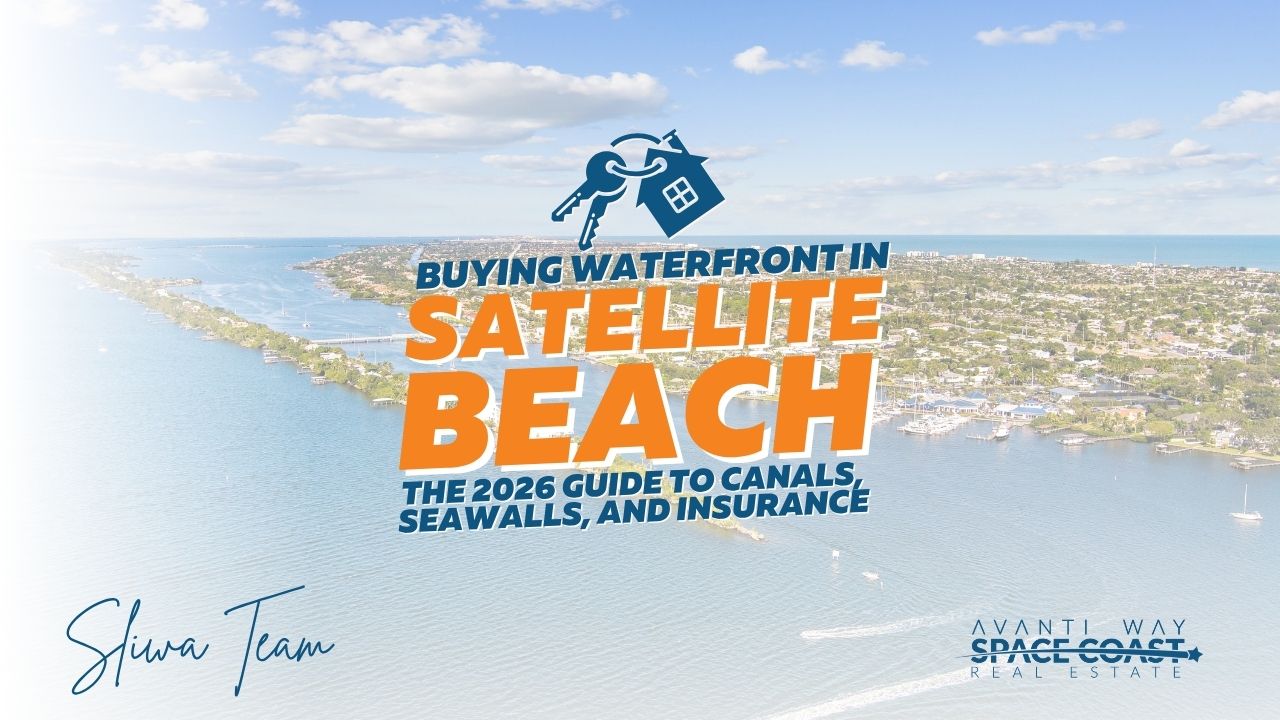
Buying Waterfront in Satellite Beach, Florida: The 2026 Guide to Canals, Seawalls, and Insurance
Buying a waterfront home in Satellite Beach, Florida requires understanding four things that a standard home inspection will not cover: canal type and water navigability, seawall condition and replacement cost, flood zone designation and whether it affects your insurance obligation, and the full insurance stack including homeowners, flood, and wind coverage. Most of Satellite Beach is in Flood Zone X, which does not require flood insurance for federally backed mortgages, but canal-front and direct Banana River properties are more likely to carry a Zone AE designation. Seawall replacement in Florida runs $150 to $600 or more per linear foot, and a single deferred replacement can exceed $90,000. Getting an elevation certificate, a seawall inspection, and an insurance quote before the inspection period closes is the minimum due diligence for any waterfront purchase in this market.
What Do I Need to Know Before Buying a Waterfront Home In Satellite Beach, Florida?
Satellite Beach waterfront buyers face a specific set of due diligence requirements that go well beyond a standard inspection.
Most of Satellite Beach is in Flood Zone X, meaning flood insurance is not required by lenders, but canal-front and direct Banana River properties are more likely to sit in Zone AE, where flood insurance is mandatory for federally backed mortgages
Seawall inspection by a licensed marine contractor is essential before closing; seawall repair runs $100 to $250 per linear foot and full replacement typically runs $150 to $600 per linear foot, with total project costs commonly reaching $90,000 to $120,000 for mid-range Florida installations
An elevation certificate documents your property's height above the Base Flood Elevation and can reduce flood insurance premiums by 20 to 60 percent; many past certificates are on file with the City of Satellite Beach
Canal type matters: navigable canals with deep water and open Banana River access carry a different price premium and a different insurance profile than interior canals or ponds
Florida's insurance market in 2026 is more stable than in recent years, but waterfront homes still require a wind mitigation inspection, a four-point inspection on older homes, and flood insurance sourced separately from your homeowners policy
Buying waterfront in Satellite Beach in 2026 is achievable with clear eyes. The buyers who run into problems are the ones who do not model flood insurance, seawall condition, and the full insurance stack until after closing.
Lourdes Sliwa is a real estate agent in Satellite Beach, Florida helping waterfront buyers build a complete cost-of-ownership picture before they make an offer, not after they close.

Satellite Beach is a legitimate waterfront market. The western border of the barrier island is the Banana River, a 31-mile brackish lagoon that connects south to the Indian River and north to Port Canaveral and the Atlantic Ocean. Canal systems throughout the city feed off the Banana River, creating waterfront lots well inland from the main river channel itself. On the eastern edge, oceanfront condos and a small number of single-family homes front the Atlantic.
What makes Satellite Beach different from most Florida waterfront markets is that a surprisingly large portion of the city sits in Flood Zone X despite being bordered by water on both sides. That creates real buying opportunities, but it also requires buyers to verify flood zone at the address level rather than assuming from the zip code or the city name. Two homes on the same street can have different flood designations depending on elevation and proximity to open water.
This guide covers the four dimensions every waterfront buyer in Satellite Beach needs to understand before writing an offer: canal types and what they mean, seawalls and what they cost, flood zones and how they work in this market, and the full insurance stack.
Understanding Satellite Beach Canal Types: Not All Waterfront is Equal
The term "waterfront" covers a wide range in Satellite Beach, and the differences between property types are significant enough to affect both price and practical use.
Direct Banana River frontage is the most valuable and most navigable position. Homes directly on the Banana River have open water access to the full lagoon system. From the river, residents can head south to the Indian River at Dragon Point, or north toward Port Canaveral and the Intracoastal Waterway. The Pineda Causeway crossing the Banana River has a 43-foot clearance, which matters to sailboat owners who want unrestricted access to the southern Intracoastal without navigating a low bridge. Direct river frontage commands the strongest premiums.
Deep-water navigable canals are the next tier. These canals connect directly to the Banana River with enough depth for recreational and offshore boats. Homes with private docks on navigable canals give owners the same practical boating access as river-front homes, at a somewhat lower price point. Dock depth and bridge clearance within the canal system matter to buyers with larger vessels and should be verified for any specific address before making an offer.
Shallow or dead-end canals exist throughout the city and require careful evaluation. Some provide adequate depth for kayaks, paddleboards, and smaller powerboats but not for anything offshore. Some dead-end and provide no navigable route to open water at all. Buyers who purchase what they believe is a boatable waterfront home and later discover the canal is too shallow or terminates before reaching the river have paid a navigability premium for a view.
Interior lakes and ponds are common in communities like Tortoise Island and throughout the DeSoto area. These provide water views and a peaceful setting but no navigable access. They are appropriately priced below canal and river frontage.
The practical test for any waterfront property: ask where a boat leaves that dock, and what size boat can do it. If the seller cannot answer that clearly, the marine contractor who inspects the seawall will be able to provide a depth reading and a navigability assessment.
➤ If you are comparing canal front, river front, ocean side, and interior neighborhoods, Best Neighborhoods in Satellite Beach, Florida: Which Area Fits Your Life in 2026? is a helpful next read. It gives buyers a clearer picture of where different waterfront options fit within the larger beachside market.
Flood Zones in Satellite Beach: A Genuine Advantage, With Conditions
Here is the finding that surprises most buyers researching waterfront in Brevard County: most of Satellite Beach is in Flood Zone X. A barrier island flanked by the Atlantic Ocean on one side and the Banana River on the other is not, in most of its geography, a high-flood-risk area for insurance purposes.
Flood Zone X means the property sits outside the Special Flood Hazard Area. Lenders with federally backed mortgages do not require flood insurance in Zone X. Premiums for optional flood coverage in Zone X typically run $400 to $1,200 per year and can provide real protection at a relatively low cost.
Flood Zone AE tells a different story. Zone AE designates the 100-year floodplain, meaning a 1 percent annual chance of flooding with an established Base Flood Elevation. Flood insurance is mandatory for federally backed mortgages on Zone AE properties. Annual NFIP premiums in Zone AE for a single-family home typically range from $2,000 to $6,000, though properties with favorable elevation certificates can come in meaningfully lower. Private flood insurers have become increasingly competitive in Florida and can offer 15 to 25 percent savings over NFIP rates for well-maintained properties in certain zones.
The Satellite Beach reality: To the surprise of buyers, most Canal-front homes close to the Banana River and direct river-frontage properties are . Much like non- waterfront homes However, flood zones are determined at the individual address, not the neighborhood. Two homes on the same canal can have different designations depending on their specific elevation relative to the Base Flood Elevation.
What to do before making an offer: Look up the specific property's flood zone designation at Brevard County’s Flood Zone Map Service using the property address. Then get a flood insurance quote from both an NFIP provider and a private carrier before the inspection period closes. Flood insurance is not a number you want to discover for the first time at the closing table.
Citizens Insurance changes in 2026: Florida's insurer of last resort, Citizens Property Insurance, now requires flood insurance for wind coverage on homes with dwelling coverage of $400,000 or more that sit in a Special Flood Hazard Area. By 2027, Citizens will require flood insurance for any home with wind protection regardless of coverage amount. Waterfront buyers who plan to use Citizens should factor this requirement into their carrying cost model from day one.
Seawalls in Satellite Beach: What Buyers Must Verify Before Closing

A seawall is the retaining structure along the water's edge that holds the land in place, protects against erosion, and provides the structural foundation for a dock. In Satellite Beach's canal system, seawalls are essentially infrastructure. A failed or failing seawall is not a minor repair. It is a project that can cost $90,000 to $120,000 or more for a mid-range Florida residential installation, and it is not something standard home inspectors are qualified to evaluate.
What a seawall inspection covers
A professional seawall inspection by a licensed marine contractor or marine engineer runs approximately $200 to $600 depending on wall length and whether it includes an underwater assessment. The inspection evaluates the structural condition of the wall panels, cap, and tiebacks, the presence of cracks, voids, or separation, soil erosion behind the wall, the condition of weep holes that allow water to drain without building hydrostatic pressure, and the overall estimated remaining lifespan of the structure.
Annual inspections are the single most cost-effective maintenance practice for waterfront homeowners. A $2,000 repair caught early can easily become a $60,000 to $80,000 problem if ignored for two or three years. Buyers evaluating a property should request the seller's inspection and maintenance history for the seawall as part of due diligence.
Seawall lifespan and material
Concrete seawalls, the most common type in Florida, typically last 30 to 50 years with proper maintenance. Vinyl seawalls can last 50 or more years. Steel seawalls are less common in residential applications and are subject to corrosion in salt water. A seawall approaching or past its expected lifespan on an older home is a deferred capital expense that should be modeled into the offer price.
What seawall repair and replacement costs in 2026
Standard seawall repairs, including crack sealing, cap replacement, and weep hole maintenance, run approximately $100 to $250 per linear foot. Full seawall replacement in Florida runs $150 to $600 per linear foot for most residential applications, with the total project cost typically falling between $40,000 and $175,000 and most mid-range installations clustering around $90,000 to $120,000. Material choice drives cost significantly: vinyl sits at the low end, concrete and steel run higher. Permits and engineering plans add $500 to $2,000 on top of construction costs. Florida requires permits for structural seawall work.
A 100-foot seawall in need of full replacement represents $65,000 to $90,000 in deferred capital. Buyers who identify a failing or borderline seawall during inspections should either negotiate a price reduction that accounts for the replacement cost or walk away if the seller is not willing to adjust.
The dock question
Most canal-front homes in Satellite Beach have or can accommodate a private dock. Buyers should verify that any existing dock has the required Brevard County permits and confirm that the dock itself is structurally sound. A dock inspection is a separate item from the seawall inspection and should be conducted by the same marine contractor in the same visit to save mobilization costs.
Lourdes Sliwa is a real estate agent in Satellite Beach, Florida helping buyers coordinate marine contractor inspections, elevation certificate requests, and insurance quotes as part of a structured waterfront due diligence process before the inspection period closes.
The Insurance Stack for Satellite Beach Waterfront Homes
Insuring a waterfront home in Satellite Beach in 2026 involves three separate coverage types that do not overlap and must each be obtained independently.
Homeowners insurance covers the structure and contents against fire, wind, theft, and most non-flood perils. It does not cover flood damage from rising water, storm surge, or groundwater. Brevard County homeowners insurance premiums run from approximately $3,944 per year for a $150,000 home to over $12,539 for a $450,000 home. Waterfront homes typically run toward the higher end of that range due to coastal proximity. The good news in 2026 is that Florida's insurance market is modestly improving: several carriers filed 5 to 10 percent rate reductions following tort reform legislation, and new insurers have entered the Florida market after years of contraction.
Flood insurance covers damage from rising water, storm surge, and groundwater. It is a separate policy that must be purchased from the NFIP or a private carrier. The Florida average flood insurance premium through the NFIP runs approximately $878 to $938 per year, but waterfront properties in Zone AE can run $2,000 to $6,000 depending on elevation, coverage amount, and construction type. Obtain a flood insurance quote from both NFIP and private carriers before closing. The difference between the two can be significant, and private carriers in Florida have become more competitive for well-maintained properties.
Wind coverage in coastal Brevard County is often obtained through a separate wind-only or wind-and-hail policy when standard carriers will not include it in the homeowners package. This is common for waterfront properties close to the coast. The wind mitigation inspection, discussed below, directly affects this premium.
Three inspections that affect what you pay
The wind mitigation inspection runs $75 to $150 and documents your roof shape, roof-to-wall connection method, opening protections (impact windows and doors), and other wind-resistant features. Strong results can reduce wind insurance premiums by up to 62 percent. It is one of the highest-return due diligence steps a waterfront buyer can take and should be completed before closing rather than after.
The four-point inspection is required by many insurers for homes that are 20 years or older. It evaluates the four systems that affect insurability: roof, electrical, plumbing, and HVAC. It runs $75 to $200. A four-point inspection that reveals a roof approaching the end of its insurable life, outdated electrical panels, or aging plumbing can either kill a deal or provide the negotiation basis to require seller repairs or price adjustments before closing.
The elevation certificate is the document that tells your flood insurer how high your lowest floor sits relative to the Base Flood Elevation established by FEMA. A favorable elevation certificate, meaning your home is built above the BFE, can reduce flood insurance premiums by 20 to 60 percent. Many past elevation certificates for properties in Satellite Beach are on file with the City. Contact the City of Satellite Beach before paying for a new survey to check whether one already exists for the address.
What Older Homes Mean for Waterfront Buyers in Satellite Beach
A significant portion of Satellite Beach's waterfront inventory was built before 2001. Florida insurers pay close attention to construction date because homes built before the state adopted its current building code standards require more scrutiny for wind resistance. Pre-2001 homes generally cost more to insure.
Roof age is the most immediate concern. Florida insurers increasingly scrutinize roofs older than 15 years, and some carriers will not write new policies on homes with roofs past 20 years. A home with an aging roof on a canal lot is not uninsurable, but the buyer should obtain an insurance commitment before closing rather than assuming the insurance will be straightforward. Metal roofs, which are common in Satellite Beach listings that have been updated, are viewed favorably by insurers and can meaningfully reduce premiums compared to older three-tab shingle roofs.
Impact windows and doors are the other upgrade that affects insurance costs and storm protection. Homes with documented impact-rated openings across all windows and exterior doors will produce better wind mitigation inspection results and lower insurance premiums than homes with partial impact protection or standard windows behind shutters.
➤ If you are comparing older waterfront homes with newer or recently updated properties, What Do Buyers Look for When Buying a Home in Satellite Beach, FL? is a helpful companion article. It explains which features matter most in today's market, including roof age, impact windows, insurance readiness, outdoor living, dock access, and overall condition.
A Waterfront Due Diligence Checklist for Satellite Beach Buyers
Before the inspection period closes on any waterfront property in Satellite Beach, buyers should have the following in hand:
Flood zone designation confirmed at the specific address via FEMA Flood Map Service Center
Flood insurance quotes obtained from both NFIP and at least one private carrier
Elevation certificate located or ordered; check with the City of Satellite Beach first
Marine contractor inspection of seawall including structural condition, remaining lifespan estimate, and repair or replacement cost range
Dock inspection confirming structural integrity and permit compliance
Wind mitigation inspection completed and results obtained
Four-point inspection completed on homes 20 or more years old
Canal navigability confirmed: water depth at the dock, connection to the Banana River, and any bridge clearance limitations
Insurance commitment from a carrier willing to write the homeowners policy before removing the inspection contingency
None of these steps is optional on a waterfront purchase. Running them in sequence during the inspection period gives the buyer the information needed to proceed confidently, renegotiate based on findings, or walk away before the contingency expires.
Quick Signs You Are Evaluating a Waterfront Home in Satellite Beach with Real Due Diligence
A buyer who is doing this right will recognize all of these markers before making a final decision:
You have confirmed the flood zone at the specific address, not just the zip code or neighborhood
You have a flood insurance quote from at least two carriers and have modeled that annual cost into your monthly carrying number
A licensed marine contractor has physically inspected the seawall and given you a written estimate of its condition and remaining useful life
You know whether the canal is navigable to the Banana River and what size boat can actually use the dock
You have the elevation certificate or know it is on file with the City of Satellite Beach
You have completed a wind mitigation inspection and know what your wind insurance will cost before closing
You have a four-point inspection on any home built before 2001 and you know the roof age and condition
Frequently Asked Questions About Buying Waterfront in Satellite Beach, Florida

What do I need to know before buying a waterfront home in Satellite Beach Florida?
The four things standard buyers overlook are: flood zone designation at the specific address, seawall condition and replacement cost, the full insurance stack including homeowners, flood, and wind coverage as separate policies, and whether the canal is navigable to open water. Most of Satellite Beach is in Flood Zone X, which does not require flood insurance.All four items should be resolved before the inspection period closes.
Are canal homes in Satellite Beach in a flood zone?
Most of Satellite Beach, including much of the canal-adjacent residential area, is in Flood Zone X, which does not require flood insurance for federally backed mortgages. Canal-front homes close to the Banana River and direct river-frontage properties may carry a Zone AE designation. Flood zone is determined at the individual address, not by neighborhood or city. Buyers should look up the specific address on the FEMA Flood Map Service Center before making an offer.
How much does flood insurance cost for a waterfront home in Satellite Beach?
In Flood Zone X, optional flood coverage typically runs $400 to $1,200 per year. In Flood Zone AE, NFIP flood insurance for a single-family home typically runs $2,000 to $6,000 per year, with the specific premium heavily influenced by the elevation certificate. Properties with favorable elevation relative to the Base Flood Elevation pay meaningfully less. Private flood carriers are often 15 to 25 percent less expensive than NFIP for well-maintained properties and should always be quoted alongside the NFIP option.
What should I look for in a seawall inspection before buying in Satellite Beach?
A licensed marine contractor or marine engineer should inspect the seawall for structural condition of panels, cap, and tiebacks; cracks, voids, or separation; soil erosion behind the wall; weep hole function; and overall remaining lifespan. The inspection should also include a water depth reading at the dock and a confirmation of canal navigability. A seawall inspection runs $200 to $600 and is one of the most important due diligence steps in any Satellite Beach waterfront purchase.
How much does seawall repair or replacement cost in Florida?
Standard seawall repairs run $100 to $250 per linear foot. Full seawall replacement in Florida runs $150 to $600 per linear foot for most residential applications, with total project costs typically falling between $40,000 and $175,000 and most mid-range installations clustering around $90,000 to $120,000. Permits add $500 to $2,000. A seawall in poor condition on a 100-foot lot represents $65,000 to $90,000 or more in deferred capital expense that should be reflected in the purchase price.
What is the difference between navigable and non-navigable canals in Satellite Beach?
Navigable canals in Satellite Beach have sufficient water depth for recreational and offshore boats and a direct connection to the Banana River system. Non-navigable canals may be too shallow for most powerboats, may dead-end before reaching the river, or may have bridge clearances that limit vessel height. The practical test is confirming the water depth at the specific dock and tracing the route from that dock to the Banana River. A marine contractor can provide a depth reading as part of the seawall inspection.
What is a wind mitigation inspection and do I need one for a Satellite Beach waterfront home?
A wind mitigation inspection documents your home's wind-resistant features, including roof shape, roof-to-wall connections, and opening protections like impact windows and doors. It runs $75 to $150 and can reduce wind insurance premiums by up to 62 percent. Any waterfront home in Satellite Beach should have a wind mitigation inspection completed before closing, not after, so the buyer can accurately model insurance costs and negotiate if significant protections are absent.
How does an elevation certificate affect flood insurance in Satellite Beach?
An elevation certificate documents your property's lowest floor height relative to the Base Flood Elevation established by FEMA. Properties with floors built above the BFE pay lower flood insurance premiums. A favorable elevation certificate can reduce flood insurance by 20 to 60 percent. Many past elevation certificates for Satellite Beach properties are on file with the City. Buyers should contact the City of Satellite Beach to check whether an existing certificate covers the property before paying for a new survey.
➤ If you are still building your budget, Moving to Satellite Beach, Florida: What It Really Costs in 2026 is a smart next read. It gives buyers a broader look at insurance, utilities, maintenance, HOA fees, and the real carrying costs that come with owning a beachside or waterfront home.
Key Takeaways
Most of Satellite Beach is in Flood Zone X, which does not require flood insurance for federally backed mortgages, but canal-front and Banana River-front properties may carry Zone AE designations where flood insurance is mandatory
Flood zone is determined at the specific address, not the neighborhood or city; buyers must verify the designation at FEMA's Flood Map Service Center before making an offer
Seawall inspection by a licensed marine contractor is non-negotiable on any Satellite Beach waterfront purchase; the inspection runs $200 to $600 and should include water depth, dock condition, and navigability confirmation
Full seawall replacement in Florida typically costs $90,000 to $120,000 for mid-range installations; a failing seawall on a 100-foot lot represents $65,000 to $90,000 or more in deferred capital that should be reflected in the purchase price
The full insurance stack for a Satellite Beach waterfront home includes homeowners, flood, and wind coverage as separate policies; buyers should obtain quotes for all three before the inspection period closes
An elevation certificate can reduce flood insurance premiums by 20 to 60 percent; past certificates for Satellite Beach properties are often on file with the City
Wind mitigation inspections run $75 to $150 and can reduce wind insurance premiums by up to 62 percent; they should be completed before closing, not after
Florida's insurance market in 2026 is modestly more stable than recent years, with several carriers reducing rates following tort reform, but waterfront properties still require more insurance complexity than inland homes
Canal navigability matters: buyers should confirm water depth, the route to the Banana River, and bridge clearances for any vessel they plan to use before removing the inspection contingency
Ready to Buy Waterfront in Satellite Beach?
Buying waterfront in Satellite Beach is not just about finding the right view. It is about understanding flood zones, insurance, seawalls, dock condition, navigability, roof age, and the full cost of ownership before you remove your inspection contingency.
If you are evaluating waterfront property, you can request the Satellite Beach Waterfront Buyer Due Diligence Guide. It gives you a practical framework for comparing canal front, Banana River, interior lake, and gated waterfront options, including communities like Tortoise Island.
You can also request a current waterfront market analysis filtered by your budget, preferred water position, boating needs, and insurance comfort level.
No pressure. Just clear local guidance so you can buy waterfront with confidence.
➤ Buyers relocating to the area should read Relocating to Satellite Beach, Florida from Out of State: What to Know Before You Move before starting their search.
Related Reads for Satellite Beach Waterfront Buyers
Living in Tortoise Island, Satellite Beach, Florida
A full look at one of Satellite Beach's most established gated waterfront communities, including homes, amenities, boating access, schools, HOA, and daily lifestyle.
Is Tortoise Island in Satellite Beach Worth the Price?
A deeper look at whether the price makes sense when you factor in dock access, water position, HOA value, school zone, privacy, and long term costs.
Tortoise Island vs Lansing Island
A side by side comparison of two of Brevard County's premier gated waterfront island communities.

Buying Waterfront in Satellite Beach, Florida: The 2026 Guide to Canals, Seawalls, and Insurance
Buying a waterfront home in Satellite Beach, Florida requires understanding four things that a standard home inspection will not cover: canal type and water navigability, seawall condition and replacement cost, flood zone designation and whether it affects your insurance obligation, and the full insurance stack including homeowners, flood, and wind coverage. Most of Satellite Beach is in Flood Zone X, which does not require flood insurance for federally backed mortgages, but canal-front and direct Banana River properties are more likely to carry a Zone AE designation. Seawall replacement in Florida runs $150 to $600 or more per linear foot, and a single deferred replacement can exceed $90,000. Getting an elevation certificate, a seawall inspection, and an insurance quote before the inspection period closes is the minimum due diligence for any waterfront purchase in this market.
What Do I Need to Know Before Buying a Waterfront Home In Satellite Beach, Florida?
Satellite Beach waterfront buyers face a specific set of due diligence requirements that go well beyond a standard inspection.
Most of Satellite Beach is in Flood Zone X, meaning flood insurance is not required by lenders, but canal-front and direct Banana River properties are more likely to sit in Zone AE, where flood insurance is mandatory for federally backed mortgages
Seawall inspection by a licensed marine contractor is essential before closing; seawall repair runs $100 to $250 per linear foot and full replacement typically runs $150 to $600 per linear foot, with total project costs commonly reaching $90,000 to $120,000 for mid-range Florida installations
An elevation certificate documents your property's height above the Base Flood Elevation and can reduce flood insurance premiums by 20 to 60 percent; many past certificates are on file with the City of Satellite Beach
Canal type matters: navigable canals with deep water and open Banana River access carry a different price premium and a different insurance profile than interior canals or ponds
Florida's insurance market in 2026 is more stable than in recent years, but waterfront homes still require a wind mitigation inspection, a four-point inspection on older homes, and flood insurance sourced separately from your homeowners policy
Buying waterfront in Satellite Beach in 2026 is achievable with clear eyes. The buyers who run into problems are the ones who do not model flood insurance, seawall condition, and the full insurance stack until after closing.
Lourdes Sliwa is a real estate agent in Satellite Beach, Florida helping waterfront buyers build a complete cost-of-ownership picture before they make an offer, not after they close.
Satellite Beach is a legitimate waterfront market. The western border of the barrier island is the Banana River, a 31-mile brackish lagoon that connects south to the Indian River and north to Port Canaveral and the Atlantic Ocean. Canal systems throughout the city feed off the Banana River, creating waterfront lots well inland from the main river channel itself. On the eastern edge, oceanfront condos and a small number of single-family homes front the Atlantic.
What makes Satellite Beach different from most Florida waterfront markets is that a surprisingly large portion of the city sits in Flood Zone X despite being bordered by water on both sides. That creates real buying opportunities, but it also requires buyers to verify flood zone at the address level rather than assuming from the zip code or the city name. Two homes on the same street can have different flood designations depending on elevation and proximity to open water.
This guide covers the four dimensions every waterfront buyer in Satellite Beach needs to understand before writing an offer: canal types and what they mean, seawalls and what they cost, flood zones and how they work in this market, and the full insurance stack.
Understanding Satellite Beach Canal Types: Not All Waterfront is Equal
The term "waterfront" covers a wide range in Satellite Beach, and the differences between property types are significant enough to affect both price and practical use.
Direct Banana River frontage is the most valuable and most navigable position. Homes directly on the Banana River have open water access to the full lagoon system. From the river, residents can head south to the Indian River at Dragon Point, or north toward Port Canaveral and the Intracoastal Waterway. The Pineda Causeway crossing the Banana River has a 43-foot clearance, which matters to sailboat owners who want unrestricted access to the southern Intracoastal without navigating a low bridge. Direct river frontage commands the strongest premiums.
Deep-water navigable canals are the next tier. These canals connect directly to the Banana River with enough depth for recreational and offshore boats. Homes with private docks on navigable canals give owners the same practical boating access as river-front homes, at a somewhat lower price point. Dock depth and bridge clearance within the canal system matter to buyers with larger vessels and should be verified for any specific address before making an offer.
Shallow or dead-end canals exist throughout the city and require careful evaluation. Some provide adequate depth for kayaks, paddleboards, and smaller powerboats but not for anything offshore. Some dead-end and provide no navigable route to open water at all. Buyers who purchase what they believe is a boatable waterfront home and later discover the canal is too shallow or terminates before reaching the river have paid a navigability premium for a view.
Interior lakes and ponds are common in communities like Tortoise Island and throughout the DeSoto area. These provide water views and a peaceful setting but no navigable access. They are appropriately priced below canal and river frontage.
The practical test for any waterfront property: ask where a boat leaves that dock, and what size boat can do it. If the seller cannot answer that clearly, the marine contractor who inspects the seawall will be able to provide a depth reading and a navigability assessment.
➤ If you are comparing canal front, river front, ocean side, and interior neighborhoods, Best Neighborhoods in Satellite Beach, Florida: Which Area Fits Your Life in 2026? is a helpful next read. It gives buyers a clearer picture of where different waterfront options fit within the larger beachside market.
Flood Zones in Satellite Beach: A Genuine Advantage, With Conditions
Here is the finding that surprises most buyers researching waterfront in Brevard County: most of Satellite Beach is in Flood Zone X. A barrier island flanked by the Atlantic Ocean on one side and the Banana River on the other is not, in most of its geography, a high-flood-risk area for insurance purposes.
Flood Zone X means the property sits outside the Special Flood Hazard Area. Lenders with federally backed mortgages do not require flood insurance in Zone X. Premiums for optional flood coverage in Zone X typically run $400 to $1,200 per year and can provide real protection at a relatively low cost.
Flood Zone AE tells a different story. Zone AE designates the 100-year floodplain, meaning a 1 percent annual chance of flooding with an established Base Flood Elevation. Flood insurance is mandatory for federally backed mortgages on Zone AE properties. Annual NFIP premiums in Zone AE for a single-family home typically range from $2,000 to $6,000, though properties with favorable elevation certificates can come in meaningfully lower. Private flood insurers have become increasingly competitive in Florida and can offer 15 to 25 percent savings over NFIP rates for well-maintained properties in certain zones.
The Satellite Beach reality: To the surprise of buyers, most Canal-front homes close to the Banana River and direct river-frontage properties are . Much like non- waterfront homes However, flood zones are determined at the individual address, not the neighborhood. Two homes on the same canal can have different designations depending on their specific elevation relative to the Base Flood Elevation.
What to do before making an offer: Look up the specific property's flood zone designation at Brevard County’s Flood Zone Map Service using the property address. Then get a flood insurance quote from both an NFIP provider and a private carrier before the inspection period closes. Flood insurance is not a number you want to discover for the first time at the closing table.
Citizens Insurance changes in 2026: Florida's insurer of last resort, Citizens Property Insurance, now requires flood insurance for wind coverage on homes with dwelling coverage of $400,000 or more that sit in a Special Flood Hazard Area. By 2027, Citizens will require flood insurance for any home with wind protection regardless of coverage amount. Waterfront buyers who plan to use Citizens should factor this requirement into their carrying cost model from day one.
Seawalls in Satellite Beach: What Buyers Must Verify Before Closing
A seawall is the retaining structure along the water's edge that holds the land in place, protects against erosion, and provides the structural foundation for a dock. In Satellite Beach's canal system, seawalls are essentially infrastructure. A failed or failing seawall is not a minor repair. It is a project that can cost $90,000 to $120,000 or more for a mid-range Florida residential installation, and it is not something standard home inspectors are qualified to evaluate.
What a seawall inspection covers
A professional seawall inspection by a licensed marine contractor or marine engineer runs approximately $200 to $600 depending on wall length and whether it includes an underwater assessment. The inspection evaluates the structural condition of the wall panels, cap, and tiebacks, the presence of cracks, voids, or separation, soil erosion behind the wall, the condition of weep holes that allow water to drain without building hydrostatic pressure, and the overall estimated remaining lifespan of the structure.
Annual inspections are the single most cost-effective maintenance practice for waterfront homeowners. A $2,000 repair caught early can easily become a $60,000 to $80,000 problem if ignored for two or three years. Buyers evaluating a property should request the seller's inspection and maintenance history for the seawall as part of due diligence.
Seawall lifespan and material
Concrete seawalls, the most common type in Florida, typically last 30 to 50 years with proper maintenance. Vinyl seawalls can last 50 or more years. Steel seawalls are less common in residential applications and are subject to corrosion in salt water. A seawall approaching or past its expected lifespan on an older home is a deferred capital expense that should be modeled into the offer price.
What seawall repair and replacement costs in 2026
Standard seawall repairs, including crack sealing, cap replacement, and weep hole maintenance, run approximately $100 to $250 per linear foot. Full seawall replacement in Florida runs $150 to $600 per linear foot for most residential applications, with the total project cost typically falling between $40,000 and $175,000 and most mid-range installations clustering around $90,000 to $120,000. Material choice drives cost significantly: vinyl sits at the low end, concrete and steel run higher. Permits and engineering plans add $500 to $2,000 on top of construction costs. Florida requires permits for structural seawall work.
A 100-foot seawall in need of full replacement represents $65,000 to $90,000 in deferred capital. Buyers who identify a failing or borderline seawall during inspections should either negotiate a price reduction that accounts for the replacement cost or walk away if the seller is not willing to adjust.
The dock question
Most canal-front homes in Satellite Beach have or can accommodate a private dock. Buyers should verify that any existing dock has the required Brevard County permits and confirm that the dock itself is structurally sound. A dock inspection is a separate item from the seawall inspection and should be conducted by the same marine contractor in the same visit to save mobilization costs.
Lourdes Sliwa is a real estate agent in Satellite Beach, Florida helping buyers coordinate marine contractor inspections, elevation certificate requests, and insurance quotes as part of a structured waterfront due diligence process before the inspection period closes.
The Insurance Stack for Satellite Beach Waterfront Homes
Insuring a waterfront home in Satellite Beach in 2026 involves three separate coverage types that do not overlap and must each be obtained independently.
Homeowners insurance covers the structure and contents against fire, wind, theft, and most non-flood perils. It does not cover flood damage from rising water, storm surge, or groundwater. Brevard County homeowners insurance premiums run from approximately $3,944 per year for a $150,000 home to over $12,539 for a $450,000 home. Waterfront homes typically run toward the higher end of that range due to coastal proximity. The good news in 2026 is that Florida's insurance market is modestly improving: several carriers filed 5 to 10 percent rate reductions following tort reform legislation, and new insurers have entered the Florida market after years of contraction.
Flood insurance covers damage from rising water, storm surge, and groundwater. It is a separate policy that must be purchased from the NFIP or a private carrier. The Florida average flood insurance premium through the NFIP runs approximately $878 to $938 per year, but waterfront properties in Zone AE can run $2,000 to $6,000 depending on elevation, coverage amount, and construction type. Obtain a flood insurance quote from both NFIP and private carriers before closing. The difference between the two can be significant, and private carriers in Florida have become more competitive for well-maintained properties.
Wind coverage in coastal Brevard County is often obtained through a separate wind-only or wind-and-hail policy when standard carriers will not include it in the homeowners package. This is common for waterfront properties close to the coast. The wind mitigation inspection, discussed below, directly affects this premium.
Three inspections that affect what you pay
The wind mitigation inspection runs $75 to $150 and documents your roof shape, roof-to-wall connection method, opening protections (impact windows and doors), and other wind-resistant features. Strong results can reduce wind insurance premiums by up to 62 percent. It is one of the highest-return due diligence steps a waterfront buyer can take and should be completed before closing rather than after.
The four-point inspection is required by many insurers for homes that are 20 years or older. It evaluates the four systems that affect insurability: roof, electrical, plumbing, and HVAC. It runs $75 to $200. A four-point inspection that reveals a roof approaching the end of its insurable life, outdated electrical panels, or aging plumbing can either kill a deal or provide the negotiation basis to require seller repairs or price adjustments before closing.
The elevation certificate is the document that tells your flood insurer how high your lowest floor sits relative to the Base Flood Elevation established by FEMA. A favorable elevation certificate, meaning your home is built above the BFE, can reduce flood insurance premiums by 20 to 60 percent. Many past elevation certificates for properties in Satellite Beach are on file with the City. Contact the City of Satellite Beach before paying for a new survey to check whether one already exists for the address.
What Older Homes Mean for Waterfront Buyers in Satellite Beach
A significant portion of Satellite Beach's waterfront inventory was built before 2001. Florida insurers pay close attention to construction date because homes built before the state adopted its current building code standards require more scrutiny for wind resistance. Pre-2001 homes generally cost more to insure.
Roof age is the most immediate concern. Florida insurers increasingly scrutinize roofs older than 15 years, and some carriers will not write new policies on homes with roofs past 20 years. A home with an aging roof on a canal lot is not uninsurable, but the buyer should obtain an insurance commitment before closing rather than assuming the insurance will be straightforward. Metal roofs, which are common in Satellite Beach listings that have been updated, are viewed favorably by insurers and can meaningfully reduce premiums compared to older three-tab shingle roofs.
Impact windows and doors are the other upgrade that affects insurance costs and storm protection. Homes with documented impact-rated openings across all windows and exterior doors will produce better wind mitigation inspection results and lower insurance premiums than homes with partial impact protection or standard windows behind shutters.
➤ If you are comparing older waterfront homes with newer or recently updated properties, What Do Buyers Look for When Buying a Home in Satellite Beach, FL? is a helpful companion article. It explains which features matter most in today's market, including roof age, impact windows, insurance readiness, outdoor living, dock access, and overall condition.
A Waterfront Due Diligence Checklist for Satellite Beach Buyers
Before the inspection period closes on any waterfront property in Satellite Beach, buyers should have the following in hand:
Flood zone designation confirmed at the specific address via FEMA Flood Map Service Center
Flood insurance quotes obtained from both NFIP and at least one private carrier
Elevation certificate located or ordered; check with the City of Satellite Beach first
Marine contractor inspection of seawall including structural condition, remaining lifespan estimate, and repair or replacement cost range
Dock inspection confirming structural integrity and permit compliance
Wind mitigation inspection completed and results obtained
Four-point inspection completed on homes 20 or more years old
Canal navigability confirmed: water depth at the dock, connection to the Banana River, and any bridge clearance limitations
Insurance commitment from a carrier willing to write the homeowners policy before removing the inspection contingency
None of these steps is optional on a waterfront purchase. Running them in sequence during the inspection period gives the buyer the information needed to proceed confidently, renegotiate based on findings, or walk away before the contingency expires.
Quick Signs You Are Evaluating a Waterfront Home in Satellite Beach with Real Due Diligence
A buyer who is doing this right will recognize all of these markers before making a final decision:
You have confirmed the flood zone at the specific address, not just the zip code or neighborhood
You have a flood insurance quote from at least two carriers and have modeled that annual cost into your monthly carrying number
A licensed marine contractor has physically inspected the seawall and given you a written estimate of its condition and remaining useful life
You know whether the canal is navigable to the Banana River and what size boat can actually use the dock
You have the elevation certificate or know it is on file with the City of Satellite Beach
You have completed a wind mitigation inspection and know what your wind insurance will cost before closing
You have a four-point inspection on any home built before 2001 and you know the roof age and condition
Frequently Asked Questions About Buying Waterfront in Satellite Beach, Florida
What do I need to know before buying a waterfront home in Satellite Beach Florida?
The four things standard buyers overlook are: flood zone designation at the specific address, seawall condition and replacement cost, the full insurance stack including homeowners, flood, and wind coverage as separate policies, and whether the canal is navigable to open water. Most of Satellite Beach is in Flood Zone X, which does not require flood insurance.All four items should be resolved before the inspection period closes.
Are canal homes in Satellite Beach in a flood zone?
Most of Satellite Beach, including much of the canal-adjacent residential area, is in Flood Zone X, which does not require flood insurance for federally backed mortgages. Canal-front homes close to the Banana River and direct river-frontage properties may carry a Zone AE designation. Flood zone is determined at the individual address, not by neighborhood or city. Buyers should look up the specific address on the FEMA Flood Map Service Center before making an offer.
How much does flood insurance cost for a waterfront home in Satellite Beach?
In Flood Zone X, optional flood coverage typically runs $400 to $1,200 per year. In Flood Zone AE, NFIP flood insurance for a single-family home typically runs $2,000 to $6,000 per year, with the specific premium heavily influenced by the elevation certificate. Properties with favorable elevation relative to the Base Flood Elevation pay meaningfully less. Private flood carriers are often 15 to 25 percent less expensive than NFIP for well-maintained properties and should always be quoted alongside the NFIP option.
What should I look for in a seawall inspection before buying in Satellite Beach?
A licensed marine contractor or marine engineer should inspect the seawall for structural condition of panels, cap, and tiebacks; cracks, voids, or separation; soil erosion behind the wall; weep hole function; and overall remaining lifespan. The inspection should also include a water depth reading at the dock and a confirmation of canal navigability. A seawall inspection runs $200 to $600 and is one of the most important due diligence steps in any Satellite Beach waterfront purchase.
How much does seawall repair or replacement cost in Florida?
Standard seawall repairs run $100 to $250 per linear foot. Full seawall replacement in Florida runs $150 to $600 per linear foot for most residential applications, with total project costs typically falling between $40,000 and $175,000 and most mid-range installations clustering around $90,000 to $120,000. Permits add $500 to $2,000. A seawall in poor condition on a 100-foot lot represents $65,000 to $90,000 or more in deferred capital expense that should be reflected in the purchase price.
What is the difference between navigable and non-navigable canals in Satellite Beach?
Navigable canals in Satellite Beach have sufficient water depth for recreational and offshore boats and a direct connection to the Banana River system. Non-navigable canals may be too shallow for most powerboats, may dead-end before reaching the river, or may have bridge clearances that limit vessel height. The practical test is confirming the water depth at the specific dock and tracing the route from that dock to the Banana River. A marine contractor can provide a depth reading as part of the seawall inspection.
What is a wind mitigation inspection and do I need one for a Satellite Beach waterfront home?
A wind mitigation inspection documents your home's wind-resistant features, including roof shape, roof-to-wall connections, and opening protections like impact windows and doors. It runs $75 to $150 and can reduce wind insurance premiums by up to 62 percent. Any waterfront home in Satellite Beach should have a wind mitigation inspection completed before closing, not after, so the buyer can accurately model insurance costs and negotiate if significant protections are absent.
How does an elevation certificate affect flood insurance in Satellite Beach?
An elevation certificate documents your property's lowest floor height relative to the Base Flood Elevation established by FEMA. Properties with floors built above the BFE pay lower flood insurance premiums. A favorable elevation certificate can reduce flood insurance by 20 to 60 percent. Many past elevation certificates for Satellite Beach properties are on file with the City. Buyers should contact the City of Satellite Beach to check whether an existing certificate covers the property before paying for a new survey.
➤ If you are still building your budget, Moving to Satellite Beach, Florida: What It Really Costs in 2026 is a smart next read. It gives buyers a broader look at insurance, utilities, maintenance, HOA fees, and the real carrying costs that come with owning a beachside or waterfront home.
Key Takeaways
Most of Satellite Beach is in Flood Zone X, which does not require flood insurance for federally backed mortgages, but canal-front and Banana River-front properties may carry Zone AE designations where flood insurance is mandatory
Flood zone is determined at the specific address, not the neighborhood or city; buyers must verify the designation at FEMA's Flood Map Service Center before making an offer
Seawall inspection by a licensed marine contractor is non-negotiable on any Satellite Beach waterfront purchase; the inspection runs $200 to $600 and should include water depth, dock condition, and navigability confirmation
Full seawall replacement in Florida typically costs $90,000 to $120,000 for mid-range installations; a failing seawall on a 100-foot lot represents $65,000 to $90,000 or more in deferred capital that should be reflected in the purchase price
The full insurance stack for a Satellite Beach waterfront home includes homeowners, flood, and wind coverage as separate policies; buyers should obtain quotes for all three before the inspection period closes
An elevation certificate can reduce flood insurance premiums by 20 to 60 percent; past certificates for Satellite Beach properties are often on file with the City
Wind mitigation inspections run $75 to $150 and can reduce wind insurance premiums by up to 62 percent; they should be completed before closing, not after
Florida's insurance market in 2026 is modestly more stable than recent years, with several carriers reducing rates following tort reform, but waterfront properties still require more insurance complexity than inland homes
Canal navigability matters: buyers should confirm water depth, the route to the Banana River, and bridge clearances for any vessel they plan to use before removing the inspection contingency
Ready to Buy Waterfront in Satellite Beach?
Buying waterfront in Satellite Beach is not just about finding the right view. It is about understanding flood zones, insurance, seawalls, dock condition, navigability, roof age, and the full cost of ownership before you remove your inspection contingency.
If you are evaluating waterfront property, you can request the Satellite Beach Waterfront Buyer Due Diligence Guide. It gives you a practical framework for comparing canal front, Banana River, interior lake, and gated waterfront options, including communities like Tortoise Island.
You can also request a current waterfront market analysis filtered by your budget, preferred water position, boating needs, and insurance comfort level.
No pressure. Just clear local guidance so you can buy waterfront with confidence.
➤ Buyers relocating to the area should read Relocating to Satellite Beach, Florida from Out of State: What to Know Before You Move before starting their search.
Related Reads for Satellite Beach Waterfront Buyers
Living in Tortoise Island, Satellite Beach, Florida
A full look at one of Satellite Beach's most established gated waterfront communities, including homes, amenities, boating access, schools, HOA, and daily lifestyle.
Is Tortoise Island in Satellite Beach Worth the Price?
A deeper look at whether the price makes sense when you factor in dock access, water position, HOA value, school zone, privacy, and long term costs.
Tortoise Island vs Lansing Island
A side by side comparison of two of Brevard County's premier gated waterfront island communities.
GET IN TOUCH!
2825 Business Center Blvd., Suite A-1, Melbourne, FL 32940
Telephone : +1 (321) 425-8552
Web : www.lourdessliwa.com
Email: [email protected]
Follow us!
Follow us!
© 2026 | Avanti Way Space Coast. Privacy Policy
GET IN TOUCH!
2825 Business Center Blvd., Suite A-1, Melbourne, FL 32940
Telephone : +1 (321) 425-8552
Web : lourdessliwa.com
Email: [email protected]
Follow us!
Follow us!
© 2026 | Avanti Way Space Coast. Privacy Policy